The Glucose-Anxiety Feedback Loop: Why Your Blood Sugar Thinks Your Netflix Queue is Life-or-Death
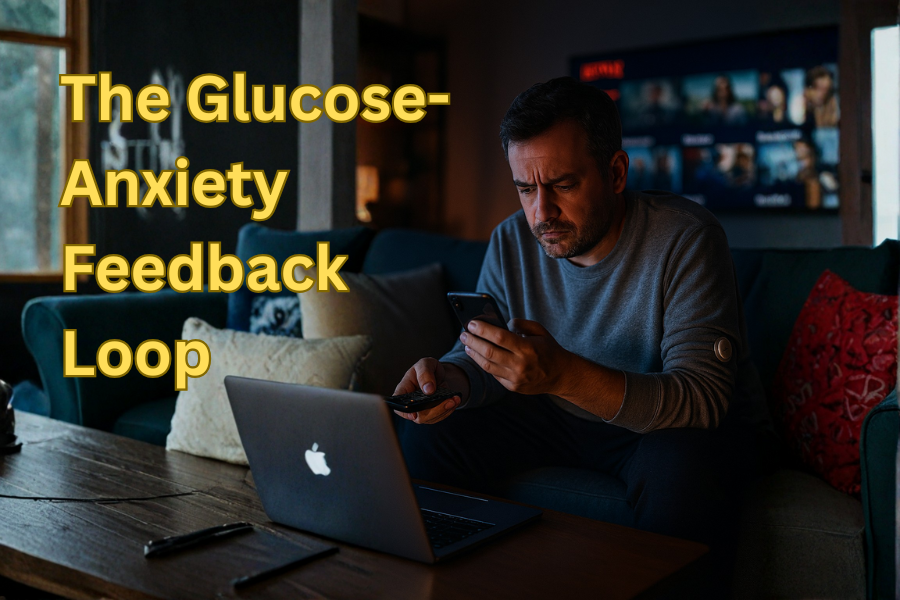
It's 9:47 PM. You're sitting on your couch, remote in hand, scrolling through Netflix for the seventeenth time. Nothing looks good. Everything looks overwhelming. Your heart rate is up slightly. Your shoulders are tense. And somewhere in the background of your consciousness, you register that feeling—the one where your body can't quite decide if it's stressed, hungry, low, or just existentially exhausted by the sheer number of true crime documentaries available.
Welcome to the glucose-anxiety feedback loop, where your blood sugar and your stress levels are locked in the world's most dysfunctional relationship, and they've decided to hold your peace of mind hostage.
Here's what nobody tells you about managing diabetes: It's not just about the carbs. It's about the fact that your body has somehow convinced itself that choosing between "The Great British Baking Show" and "another murder mystery" carries the same physiological weight as escaping a hungry lion.
Let me explain how we got here—and more importantly, how we get out.
When Your Stone Age Brain Meets Your Digital Age Life
Your body is running software that was last updated somewhere around 50,000 BCE. Back then, stress meant actual, immediate danger: predators, rival tribes, that sketchy-looking berry you probably shouldn't have eaten. Your stress response—that cascade of cortisol and adrenaline—was designed to save your life by dumping glucose into your bloodstream for quick energy. Fight or flight, baby.
Fast forward to today. Your brain's threat-detection system can't tell the difference between an actual predator and your inbox. Or between a genuine emergency and the fact that you have 47 browser tabs open, three unread articles about "optimizing your morning routine," and a nagging feeling that you should probably be doing something more productive than doomscrolling.
So what does your helpful, well-meaning, completely outdated stress response do? It dumps glucose into your bloodstream. Because surely, if you're this stressed about whether to watch "Stranger Things" or finally tackle that documentary about ocean microplastics, you must need energy to run for your life.
Except you don't. You're sitting on a couch. In your pajamas. The only thing you're running from is the vague sense that you're not using your evening "productively enough."
The Vicious Cycle Nobody Warned You About
Here's where things get really fun. When you have diabetes, this stress-glucose dump doesn't just disappear. It hangs around. Your blood sugar rises. You check your CGM. The number is higher than you want. And now you're stressed about being stressed, which triggers more cortisol, which raises your glucose more, which stresses you out more, which...
You see where this is going.
I call this the "glucose-anxiety doom spiral," and if you've been living with diabetes for more than about twenty minutes, you've probably experienced it. It's that special brand of meta-stress where you become anxious about your anxiety affecting your blood sugar, which makes you more anxious, which affects your blood sugar more, and suddenly you're in a philosophical crisis about whether knowing your blood sugar in real-time is actually making things worse.
(Spoiler alert: The CGM isn't the problem. The problem is that we're trying to manage a chronic condition using a nervous system that thinks every mild inconvenience is a saber-toothed tiger.)
The Science Behind the Spiral
Let me give you the technical version, because I know some of you love the nerdy details as much as I do.
When you experience stress—whether it's legitimate (a work deadline, a family conflict, an actual emergency) or manufactured (social media, decision fatigue, wondering if you remembered to set your alarm)—your hypothalamus signals your adrenal glands to release cortisol and adrenaline. These hormones trigger your liver to release stored glucose through a process called gluconeogenesis. In a person without diabetes, insulin would swoop in to escort that glucose into cells.
In those of us with diabetes? Not so much. That glucose just... hangs out. Raising your blood sugar. Triggering inflammation. Making your cells more insulin resistant. And here's the kicker: high blood sugar itself is a stressor to the body, which triggers more cortisol, which raises blood sugar more.
It's a feedback loop so elegant it would be beautiful if it weren't so annoying.
And it gets worse. Chronic stress doesn't just affect your blood sugar in the moment. Over time, elevated cortisol increases visceral fat, promotes insulin resistance, disrupts sleep (which further dysregulates blood sugar), and dampens your body's ability to manage inflammation. It's like compound interest, except instead of building wealth, you're building metabolic chaos.
The Breathing Pattern You're Probably Doing Right Now
Here's a quick test. Without changing anything, notice your breathing right now. Is it deep and full, or shallow and restricted? Are you breathing into your belly, or just into your upper chest? Are you holding your breath between scrolls?
If you're like 80% of people reading content on screens, you've unconsciously shifted into what researcher Linda Stone calls "email apnea" or "screen apnea"—a pattern of shallow breathing or breath-holding that occurs when we're focused on digital devices. This restricted breathing triggers your sympathetic nervous system (your fight-or-flight response), which signals to your body that you're under threat, which releases stress hormones, which raise your blood sugar.
You're literally stressing yourself into higher glucose by the way you're breathing while reading an article about glucose and stress. The irony is not lost on me.
The good news? This is one of the easiest parts of the loop to interrupt.
Breaking the Loop: Practical Strategies That Actually Work
I'm not going to tell you to "just relax" or "stop stressing." That's like telling someone with diabetes to "just make insulin." Helpful? No. Annoying? Absolutely.
Instead, here's what actually works—techniques I use daily to interrupt the glucose-anxiety feedback loop before it gains momentum.
The 4-7-8 Reset
When I notice my blood sugar climbing without a food explanation, or when I catch myself in the anxiety spiral, I use the 4-7-8 breathing technique. Inhale through your nose for four counts, hold for seven, exhale through your mouth for eight. Do this four times.
This isn't woo-woo. It's physiology. The extended exhale activates your parasympathetic nervous system—your "rest and digest" mode—which directly counters the stress response. I've watched my CGM trend line literally change direction after doing this for two minutes.
The Body Scan Speedrun
Full body scan meditations are great, but when you're in the middle of a stress spiral, who has 20 minutes? I do a condensed version: Starting at my feet, I quickly move my attention up through my body, releasing any tension I notice. Feet, calves, thighs, belly, chest, shoulders, jaw, eyes, forehead. Takes about 60 seconds. Often, I discover I've been clenching my jaw or holding my shoulders up by my ears without realizing it.
The Five-Minute Freedom Rule
When decision fatigue is triggering stress (What should I watch? What should I eat? What should I work on?), I permit myself to make the "wrong" choice. Pick anything. Choose the first option. Make the "bad" decision and commit to it for five minutes. The stress of indecision is often worse for your blood sugar than the actual choice.
That Netflix dilemma? Set a timer for 60 seconds. Pick something. If you're still not into it after five minutes, pick something else. The goal isn't to find the "perfect" show—it's to stop flooding your system with stress hormones over something that genuinely doesn't matter.
The Mindfulness Angle (Without the Eye-Rolling)
I know, I know. "Mindfulness" has become such a buzzy, commercialized concept that it's easy to dismiss. But here's what mindfulness actually means in the context of the glucose-anxiety loop: It's noticing when you're in the spiral before you're three hours deep.
It's catching yourself holding your breath while reading email. Recognizing that your shoulders are up by your ears. Noticing that you're stress-eating not because you're hungry, but because your cortisol is up and your brain is seeking quick relief through dopamine hits from sugar or salt.
In my meditation book project, I talk about how these contemplative practices aren't about achieving some blissed-out state where nothing bothers you. They're about developing enough awareness to catch yourself before the automatic patterns take over. Before the stress response cascades into a glucose spike. Before the anxiety about your blood sugar becomes worse than the actual blood sugar.
You don't need to be a meditation master. You just need to notice. And then choose differently.
The Bigger Picture: Redefining "Control"
Here's what I've learned after four decades with this condition: The goal isn't perfect blood sugar control. It's building enough resilience and awareness that the inevitable stressors of life don't completely derail you.
You're going to have stressful days. Your blood sugar is going to spike sometimes for reasons that have nothing to do with food. Your CGM is going to alarm at inconvenient moments. You're going to feel overwhelmed by the sheer number of variables you're supposed to "manage."
But you can interrupt the loop. You can train your nervous system to distinguish between Netflix indecision and actual danger. You can build practices that short-circuit the spiral before it gains momentum.
The glucose-anxiety feedback loop is real. It's powerful. It's rooted in ancient biology colliding with modern life. But it's not unbreakable.
Sometimes the most radical act of diabetes management isn't counting carbs or timing insulin. It's taking three deep breaths and remembering that your body doesn't actually need to fight or flee from your to-do list.
Your blood sugar will thank you. Your nervous system will thank you. And honestly, you might finally finish that show you've been meaning to watch.
Just maybe skip the murder mysteries before bed. Your cortisol levels have been through enough.
What patterns have you noticed between your stress levels and blood sugar? I'd love to hear your experiences in the comments. And if you found this helpful, consider sharing it with someone else who might be stuck in the glucose-anxiety spiral. Sometimes knowing you're not alone in the struggle is the first step toward breaking the loop.